

BQool Alternative: Why Sellers With 1,000+ Listings Are Choosing Alpha Repricer in 2025
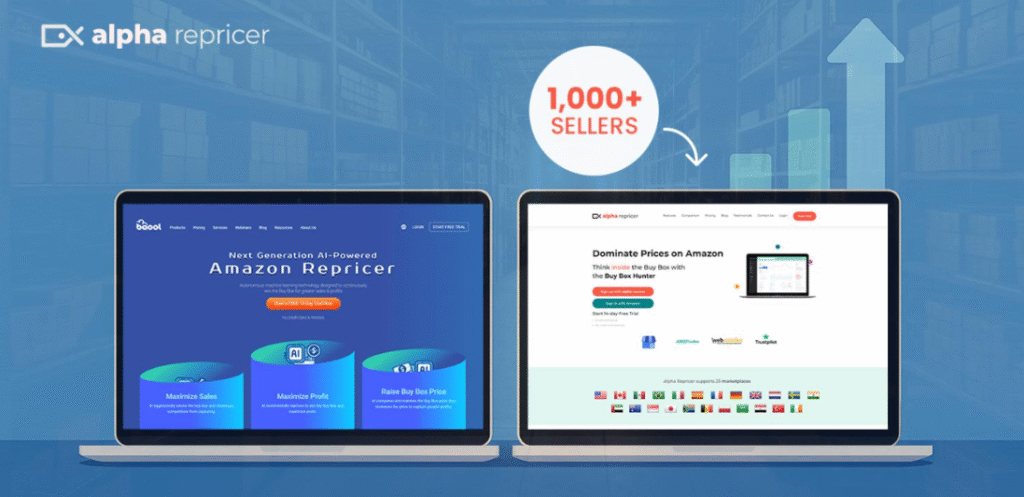
Amazon in 2025 is not the marketplace it used to be. Competition moves faster, Buy Box patterns shift without warning, and sellers with thousands of SKUs now depend on repricing tools the way they depend on inventory and fulfillment. For years, BQool has held a familiar place in this ecosystem, especially among mid-sized and enterprise sellers. Its mix of rule-based repricing, conditional triggers, and AI modes has made it a solid choice for businesses that want structure and reliability. But this year, a noticeable shift is taking place. Sellers with 1,000 listings and above are exploring alternatives that offer more speed, more control, greater international reach, and smoother long-term scalability. One name that keeps coming up is Alpha Repricer. This blog explains why. Where BQool Still Serves Sellers Well BQool continues to bring value for many sellers. Its conditional repricing, traditional rules, Buy Box logic, and detailed dashboards remain helpful for businesses that prefer a predictable, familiar system. It covers a wide range of Amazon regions and provides mixed repricing strategies that work for stable catalogs. However, the needs of high-volume sellers in 2025 are different from what they were a few years ago. Scaling from 1,000 to 10,000 listings requires more flexibility, deeper automation, and faster reaction times. That is where sellers start looking beyond BQool. Why Alpha Repricer Is Standing Out in 2025 Sellers do not switch tools without a solid reason. When a business crosses the 1,000-listing mark, it needs a repricer that supports growth instead of slowing it down. Alpha Repricer is becoming the preferred choice because it delivers exactly that. 1. The speed advantage sellers can see A major driver behind this shift is Alpha Repricer’s fast, continuous repricing performance. It updates prices in real time as the market changes, and the difference becomes obvious during peak competition hours. Sellers notice quicker Buy Box recovery, sharper reactions during sudden price drops, and higher overall stability. 2. Smarter Buy Box behavior with Buy Box Hunter Alpha Repricer’s Buy Box Hunter is one of its strongest tools. Instead of blindly undercutting, it studies the Featured Offer pattern and reacts in a way that protects profit while keeping the seller competitive. Sellers mention that this behavior feels more “aware” and more market-sensitive than traditional rule-based undercutting. It is especially useful in categories where Buy Box rotation changes wildly throughout the day. 3. Strong global reach through 23 Amazon marketplaces For sellers expanding internationally, Alpha Repricer offers support for 23 Amazon marketplaces with all pricing, Min and Max settings, fees, and shipping values shown in local currency. This gives sellers an easier and more accurate way to manage pricing across regions like Europe, the Middle East, North America, and Asia Pacific without switching between tools or manually converting fees. 4. Repricing strategies that cover every selling style Alpha Repricer supports a wide spectrum of repricing approaches. It handles AI-driven repricing, business repricing, private label repricing, cross-ASIN repricing, sales velocity-based repricing, and condition-specific repricing. This range helps sellers adapt their strategy to each ASIN instead of forcing one rule on everything. 5. Competitor control that feels genuinely powerful High-volume sellers often face noisy competition that disrupts pricing. Alpha Repricer makes it easy to filter out new sellers, low-feedback sellers, distant-region sellers, slow shippers, and any competitor that does not match your criteria. Sellers moving from BQool frequently mention that competitor filtering on Alpha feels more intuitive and more practical for daily operations. 6. Automation that works quietly in the background One of the biggest advantages of Alpha Repricer is its automation. It sets Min and Max automatically when new items arrive, attaches strategy profiles without manual effort, updates listings via FTP, restores prices after suppression, and uses reaction plans to respond instantly to market conditions. Sellers with busy operations appreciate that the tool handles repetitive tasks without constant intervention. 7. Clear insights and an easy-to-read dashboard Alpha Repricer provides clean visibility into Buy Box rotation, price changes, competitor actions, marketplace performance, and SKU-level history. Sellers switching over often highlight that the dashboard feels lighter, faster, and easier to understand while still offering detailed insights. 8. A single system built to handle growing ASIN counts Instead of repeating the word “catalogs,” let’s put it simply: Alpha Repricer handles growth smoothly. Whether a seller manages 1,200 ASINs or moves toward 6,000 or 10,000, the system keeps up. Its speed stays consistent, automation works the same way, and the platform remains easy to navigate. Sellers at scale notice that this stability lets them grow without changing tools again. Is Alpha Repricer the right BQool alternative for every seller Some sellers prefer staying within the structure they know. If their workflow is built around BQool’s conditional rules or if they simply enjoy its interface, they may remain comfortable with their current setup because BQool continues to be a solid repricer. But for sellers looking for: Alpha Repricer stands ahead in most side-by-side comparisons. Sellers managing 5,000 listings or more also benefit from dedicated onboarding support. If they choose onboarding, they receive an extended free trial, two additional weeks on top of the standard two-week trial; giving them more time to test the system with a large inventory. It is not about replacing BQool due to a flaw. It is about choosing a repricer that matches the pace of modern Amazon markets where sellers need quicker decisions, smarter Buy Box awareness, and tools that help them manage growth with ease. Final Thoughts: Why More Sellers Are Shifting in 2025 The Amazon ecosystem in 2025 rewards sellers who move quickly, react intelligently, and stay competitive without burning margin. This has pushed more businesses to look for repricers that offer real-time pricing, flexible strategies, deeper automation, and smooth marketplace expansion. Alpha Repricer brings all these strengths together. For sellers handling 1,000 listings and beyond, it is emerging as a stronger, faster, and more scalable choice in today’s fast-paced environment. If you want a repricer that grows with you in 2025, Alpha Repricer stands ready for that
Aura vs. Alpha Repricer: A Clear Comparison for Amazon Sellers
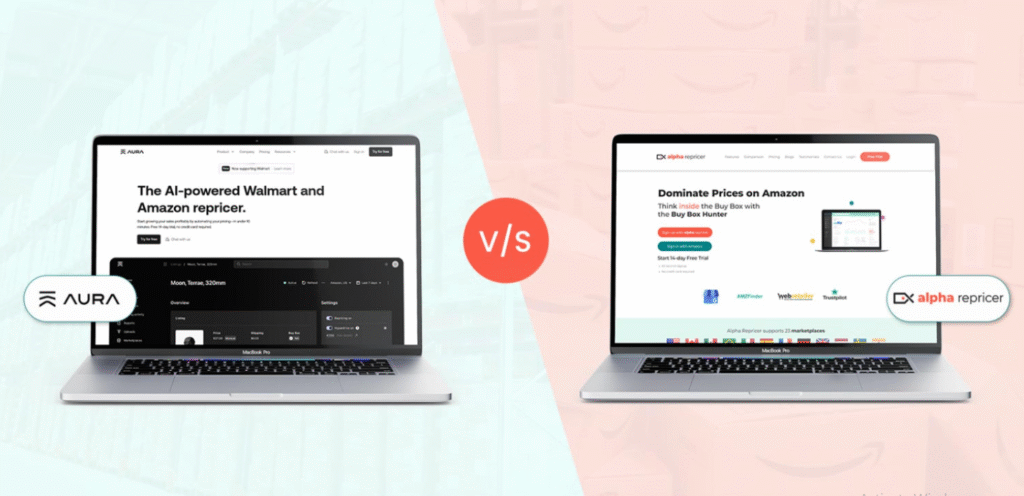
Introduction Every Amazon seller knows that pricing is where the real competition happens. Staying visible, profitable, and consistent across marketplaces depends on how well you manage your prices. Repricing tools have become essential for sellers who want to compete smartly without cutting corners. Two names that often come up are Aura and Alpha Repricer. Both claim to help sellers stay ahead of the curve, but the way they work and the value they deliver are quite different. This comparison explores their main features, automation capabilities, and how each tool supports different types of Amazon businesses. Repricing Approach Aura works on an algorithmic system that uses artificial intelligence to decide price adjustments automatically. It’s designed for sellers who want minimal manual input and prefer AI to handle daily pricing changes. Alpha Repricer uses intelligent automation combined with flexible rule setups. Sellers can choose between dynamic, velocity-based, business, or private-label repricing. It also supports Cross-ASIN and Yo-Yo repricing, giving users multiple strategies to compete smartly while maintaining profitability. This flexibility lets sellers keep full control of their pricing approach without needing to rely completely on automated decisions. Marketplace Reach Aura supports both Amazon and Walmart marketplaces. This makes it appealing for sellers managing listings across multiple retail channels. Alpha Repricer focuses exclusively on Amazon, covering 23 marketplaces worldwide. Its system is designed around Amazon’s structure, giving users better alignment with Amazon policies, regional trends, and real-time competition. Sellers expanding globally within Amazon’s ecosystem benefit from consistent repricing performance across all marketplaces. Automation and Real-Time Performance Aura operates at a very fast pace, often adjusting prices within seconds. This speed supports sellers who prefer an AI-driven structure for frequent updates. Alpha Repricer also delivers quick repricing cycles and now includes real-time margin protection. This feature ensures that prices move competitively without eating into profit margins. It consistently performs well for sellers of all sizes, including those managing large inventories, allowing users to automate most tasks while still defining their profit limits, business goals, and inventory rules. Control and Customization Aura provides automated workflows that run without much need for manual input. It’s convenient, but customization options are relatively limited. Alpha Repricer allows sellers to build their own pricing logic. Whether it’s setting velocity triggers, managing private-label items separately, or applying inventory-based rules, sellers have complete freedom to create systems that match their business models. Bulk uploads, filtering tools, and category management make handling large inventories simple and efficient. Analytics and Dashboard Aura offers performance tracking that highlights pricing results and sales changes. Alpha Repricer goes deeper into analytical control with a complete dashboard showing performance by SKU, strategy type, and marketplace. It helps sellers understand which strategies are most profitable and when to adjust pricing plans. Pricing and Value Aura’s subscription cost is based on sales volume. This can increase as the business grows, making it more suitable for large enterprises. Alpha Repricer offers multiple affordable plans, starting at $29 per month for entry-level tiers. Sellers can upgrade as they expand without facing sudden cost jumps. Its trial period also gives sellers a fair chance to evaluate all features before committing. Why You Should Choose Aura Why You Should Choose Alpha Repricer Conclusion Both Aura and Alpha Repricer help Amazon sellers stay competitive, but they serve slightly different needs. Aura fits sellers who want full automation across multiple marketplaces. Alpha Repricer is designed for sellers who want both automation and control within Amazon’s ecosystem, with flexible strategies that match real business goals. If your main focus is long-term growth on Amazon and you want to balance speed, control, and profitability, Alpha Repricer stands as the stronger, more complete solution for today’s Amazon marketplace.
How New U.S. Tariffs on Chinese Imports Are Impacting Amazon Sellers: Challenges and Opportunities

In 2025, the U.S. government, under President Donald Trump, introduced steep tariffs on imports (specifically Chinese imports), which significantly affect businesses that rely on Chinese suppliers. These tariffs, reaching as high as 145%, aim to address trade imbalances and intellectual property concerns. This move significantly impacts two kinds of sellers: those based in the U.S. who source products from outside the country (especially from China), and international sellers who ship to the U.S. market. For Amazon sellers who source products from China, this could mean higher costs and potential disruptions in their operations. This blog will explore the challenges Amazon sellers are facing due to these tariffs and the opportunities that could arise. By adapting to changes in supply chains, adjusting pricing strategies, and exploring alternative suppliers, sellers can continue to thrive in a shifting marketplace. Here, we’ll guide you through practical solutions to help navigate these challenges and capitalize on new growth opportunities. Overview of the New Tariffs Under the new tariff regime, goods imported from China are facing tariffs as high as 145%. This increase comes as part of ongoing efforts to reduce the U.S. trade deficit and protect domestic manufacturing. These tariffs affect a wide array of products, ranging from electronics to household goods, disrupting the established global supply chain. Challenges for Amazon Sellers Higher Costs The most immediate impact for Amazon sellers is the rise in import costs. As tariffs increase, the cost of Chinese products grows, forcing sellers to either raise their prices or absorb the extra cost. The latter may erode profit margins, which is especially challenging for smaller businesses with tighter margins. The decision between raising prices or taking a financial hit is a significant hurdle. Supply Chain Disruptions Sellers are also dealing with delays and higher shipping costs. Manufacturers in China may struggle to adjust to the new tariffs, leading to production delays. This disrupts inventory management, causing potential stock shortages. Sellers using just-in-time systems or long lead times may experience heightened risks of stockouts, hurting sales and customer satisfaction. Competitive Pressures Chinese sellers, who represent a large portion of Amazon’s marketplace, face increased costs. This could make their products less competitive, presenting an opportunity for U.S.-based sellers. However, some Chinese sellers are relocating their production to countries like Vietnam or Mexico to avoid tariffs, leading to a more complex global competition. Potential Opportunities for Amazon Sellers Reduced Competition from Direct-to-Consumer Platforms Platforms like Shein and Temu, known for selling low-cost Chinese goods directly to U.S. consumers, are feeling the pinch from these tariffs. As their prices increase, many consumers might turn to Amazon for more affordable alternatives. Sellers who can offer competitive prices while maintaining quality may see a surge in demand. Diversifying Supply Chains Sellers who shift their sourcing away from China may reduce their exposure to the steep tariffs targeting Chinese imports. Countries like India, Vietnam, and Mexico have become attractive alternatives due to competitive manufacturing costs and growing export capabilities. While these countries are also now subject to U.S. tariffs, though generally lower than those on Chinese goods, diversifying supply chains can still help Amazon sellers mitigate risks, stabilize pricing, and build resilience against future trade policy changes. How Sellers Can Navigate the Changes Exploring Alternative Suppliers Building relationships with manufacturers in lower-tariff countries is a proactive strategy. Countries such as Vietnam, India, and Mexico offer viable alternatives to Chinese suppliers, reducing tariff exposure. Pricing Strategies Dynamic pricing tools, such as an Amazon repricing tool, can help Amazon sellers adjust their prices according to increased costs while remaining competitive. This flexibility ensures sellers don’t lose customers due to price hikes. Optimizing Inventory Management Amazon sellers should optimize inventory management to prevent stockouts. Planning ahead for peak seasons and staying on top of supply chain disruptions are key steps in maintaining consistent stock. Staying Updated The dust has not yet settled, as diplomatic talks continue in the background. In this evolving landscape, keeping up with tariff changes and trade policies is crucial for informed decision-making. Sellers are encouraged to stay updated through reliable industry news sources and official trade announcements to adapt quickly and protect their business interests. Conclusion The increased tariffs on Chinese imports present a mixed bag of challenges and opportunities for Amazon sellers. While rising costs and supply chain disruptions may initially hurt, diversifying supply chains and adjusting pricing strategies can help mitigate the effects. Moreover, reduced competition from platforms like Shein and Temu could open up new avenues for growth. By staying adaptable and informed, Amazon sellers can navigate these changes and continue to thrive in a shifting marketplace.
Boost Your Sales Effectively with an Amazon PPC Campaign: Expert Tips from Alpha Repricer

To boost sales with Amazon PPC, use clear ad copy and relevant keywords to attract buyers. High-quality images help increase clicks. Start with automatic targeting to find effective keywords. Regularly check and adjust your campaign for the best results.